

Staying Soft in a Cold World
/The following is a reflection inspired by the FabricTV+ series, specifically the questions posed to us by the show Andor.
All words and photographs are offerings by Jeanette Mayo.

“Frost feathers” by Jeanette Mayo
Despite being a decades long transplant, I’ve never quite warmed up to our lengthy and harsh Minnesota winters, though my earth-loving nature deeply appreciates the season’s beauty and quiet purpose. The one aspect of winter I look forward to is the magical frost that covers my apartment windows during especially frigid stretches, often leaving heart or creature shapes, blocking the outside world with thick, intricate frosty “feathers” through which I view sunrise or sunset in an enchanted, abstractly distorted way. Intricate icicles, delicate hoarfrost, thickly frozen lakes and embedded but still vivid leftover leaves have been instruments of fascination for this native Texan.
Then, this season, “ice” took on a whole new meaning. All caps, like a perpetual shout. ICE. The past several months became a distorted dystopian world where every day feels like a trip to the Dread, Wrath and Beyond store. NOT NICE. My usual coping mechanism of treasure hunting for beauty, wonder, and awe through images and words has felt self-centered and privileged. I leaned heavily on the wisdom of my luminaries, current and historic: “Let everything happen to you, beauty and terror.” (Rainer Maria Rilke) Beauty, terror, check. Now what?
Witnessing my internal narrative while trying to navigate this world of local occupation and dehumanization has become crucial as I, like my fellow Minnesotans, have reactively reeled from blow after violent blow and new memorials sprung up at familiar intersections. What stories am I telling myself about the “enemy”, about people who don’t seem as devastated by these events as I am, about my own value compared to “braver” helpers? Who am I demonizing? A Facebook post by local singer/songwriter Neal Hagberg (of the beloved folk duo Neal and Leandra) on January 22nd stopped me in my judgmental tracks; upon encountering three idling trucks at the Lake Harriet Bandshell parking lot, and after seeing the gun on the man who had gotten out, he realized they were ICE agents. He writes:
“I walked past, raised my mittened hand and I said good morning. He turned and looked at me and I see he’s just a kid, 30 years old or so, a face like the face of so many people I love in my life. He said good morning.
I said how are you today and he said freezing my ass off and I said that would be Minnesota and this is mild. He laughed, just as the people I love laugh, and began to get into his truck again. I said please, please, please be kind. It’s the first thing that came to my mind and blurted out. He stopped for a second and he looked at me and he said, not with sarcasm, you be kind too, and I said, I am.”
This heartful example of humanity absolutely blew me away. Weeks into this federal “surge”, I had to admit I would not have been capable of such a civil exchange, given the opportunity. My response to an ICE vehicle that passed me as I walked to my car around that time was to flip them the bird, though I fearfully waited until they were farther away. I was succumbing to the cold-heartedness and frozen-in-fear cliches. Kate Bowler’s words in her February 4th Substack essay, Living with the Ache, ring true as I recall Neal’s story: “Not because danger isn’t real—but because fear does not get to decide what makes us human.”
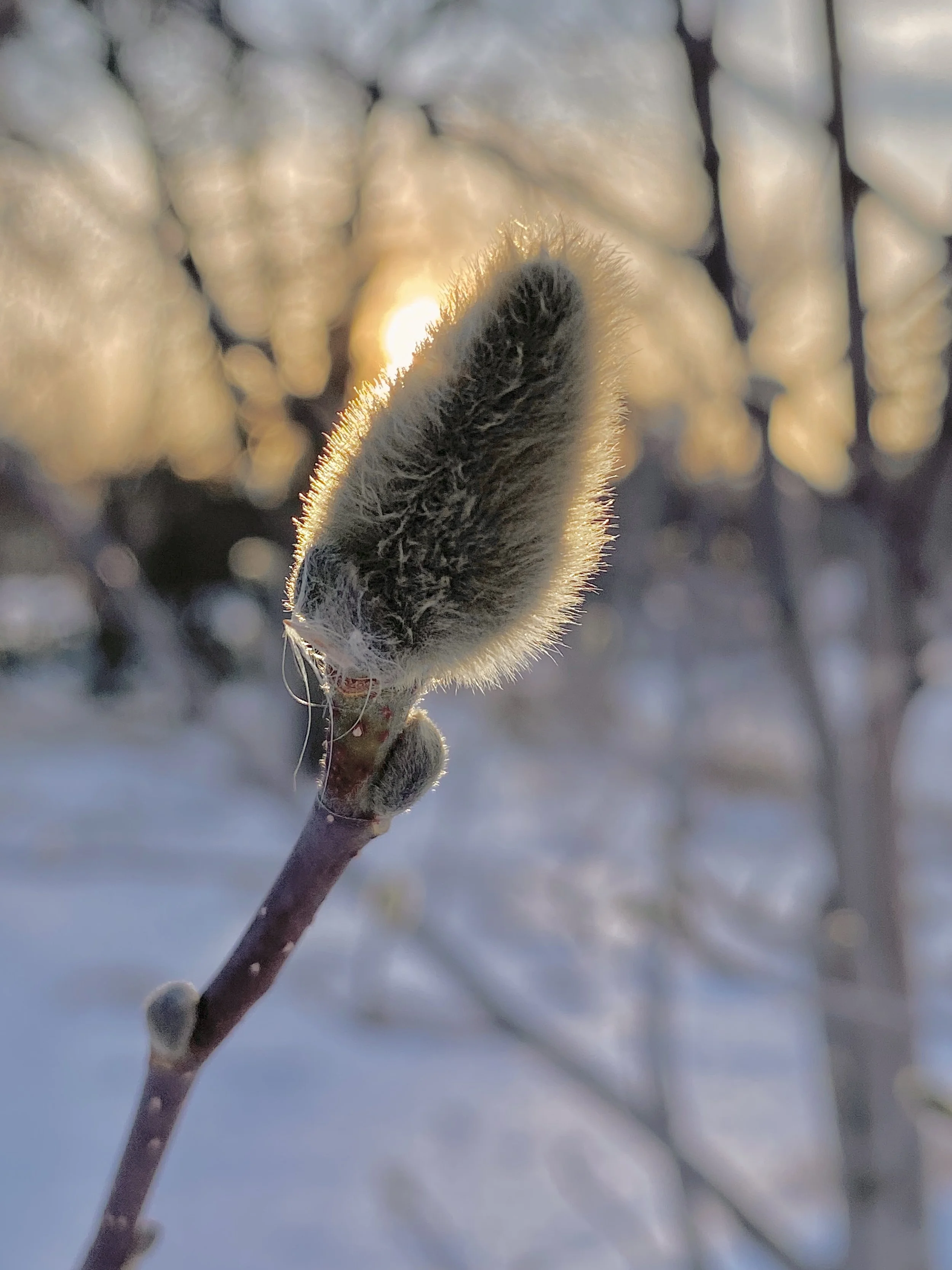
“Magnolia Bud at Sunset” by Jeanette Mayo
Pastor Ian asked us this past Sunday: What softens you back into your humanity? In my own turmoil toggling between fear, rage and despair, I did what I usually do and sought wisdom from Mother Nature on a warmish sunny day. I visited the little magnolia tree at my nearby cemetery, whose remarkable fuzzy buds stand out in a harsh landscape. Winter is not a soft season: frigid winds bite, earth hardens, water freezes, tenderness hibernates or migrates, exposure can be fatal. I reflected on my own lack of softness as the militarized occupation of my city continues. The brutality I’ve witnessed in citizen and journalist videos hardens me into brittleness, and yes, reactive hate. I think about Renee Nicole Good’s kind last words to her shooter, compared to his cruel ones as she died. I think about Alex Pretti’s last gesture and words of care, “Are you okay?”, compared to the heartlessness of his killers. I don’t know how to stay soft when righteous anger is justified. Yet here is life wrapped protectively in a firm shell topped by soft fuzz, waiting for the fullness of time. Somehow this stirs hope in me.
Staying human requires, well, other humans. Such a communal burden cannot be carried alone. In a recent long conversation of grief and lament with an equally heartbroken friend who used to live in Minneapolis, he shared that his cousin who still lives here felt a calling that her contribution would be to pray for our president. Once again, I was forced to look in the mirror. Despite trying to convince myself that the spectrum of support is broad, and every degree of it holy (i.e., my quiet contributions matter too), it would never have occurred to me to choose that particular person as the recipient of my prayers. The binary of good and evil – which admittedly does make a satisfying story – still pulls at me, even with my penchant for understanding complexity. Pastor Ian reminded us of this as well, how Jesus (Matthew 5:43-48) calls people living under occupation to “love in a way that refuses to mirror the violence and dehumanization around them.” Say hello to someone others would recoil from, as Neal Hagberg did: “And if you greet only your brothers and sisters, what more are you doing than others?” (5:48) “And so we keep choosing tenderness”, Kate Bowler writes, “even when it costs us something. We keep choosing courage, even when it costs us something.” It takes vulnerability and bravery to admit my conditioned biases, the ease with which I resort to us versus them thinking.
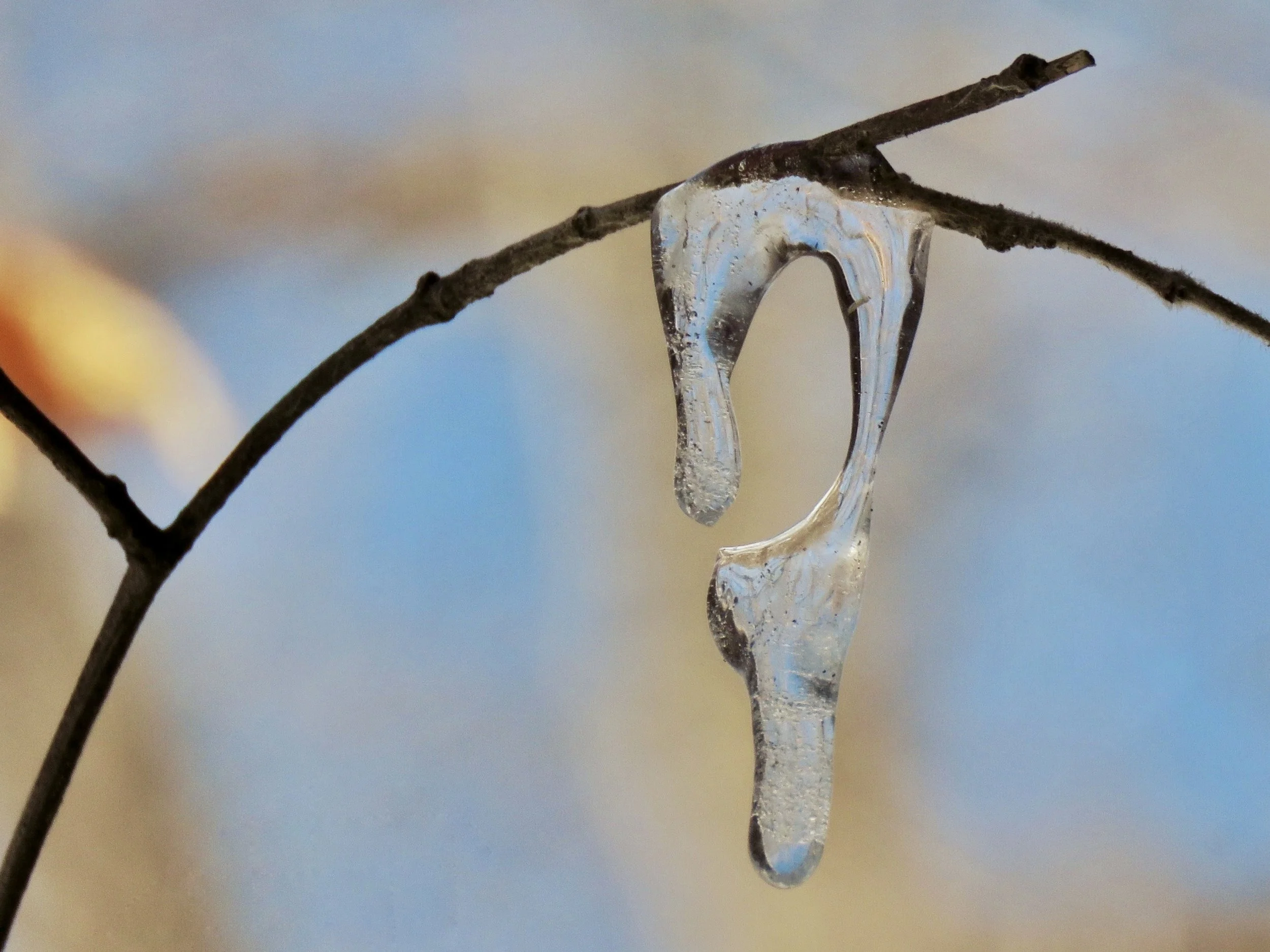
“Question mark Icicle” by Jeanette Mayo
Years ago, I spotted an icicle shaped like a question mark on a tree branch at a favorite nature center. Although an exclamation point seems better suited for these turbulent times, so many vehement “Why??”s, “What??”s and “How??”s have fled my lips lately. I am reminded of poet Rainer Maria Rilke’s gentle guidance to live into the answers in the fullness of time. It is hard to “try to love the questions themselves” when they are borne of witnessed cruelty. Patience, not my strong suit. Uncertainty, undesirably uncomfortable. Justice has a too long arc. And yet, if I can stay curious, lean into not knowing, wrestle with my very human reactivity and not harden into hatred and “othering”, maybe there’s hope. As Kate Bowler wisely writes,
“We keep doing the next small, ordinary right thing.
We work out our hope like it is a muscle, not a mood.
And somehow, this is how we stay human—together, anyway.”